Your Regulatory Impact Assessment Agent for Turning Change into Action Watch Ria in Action
 August 7, 2026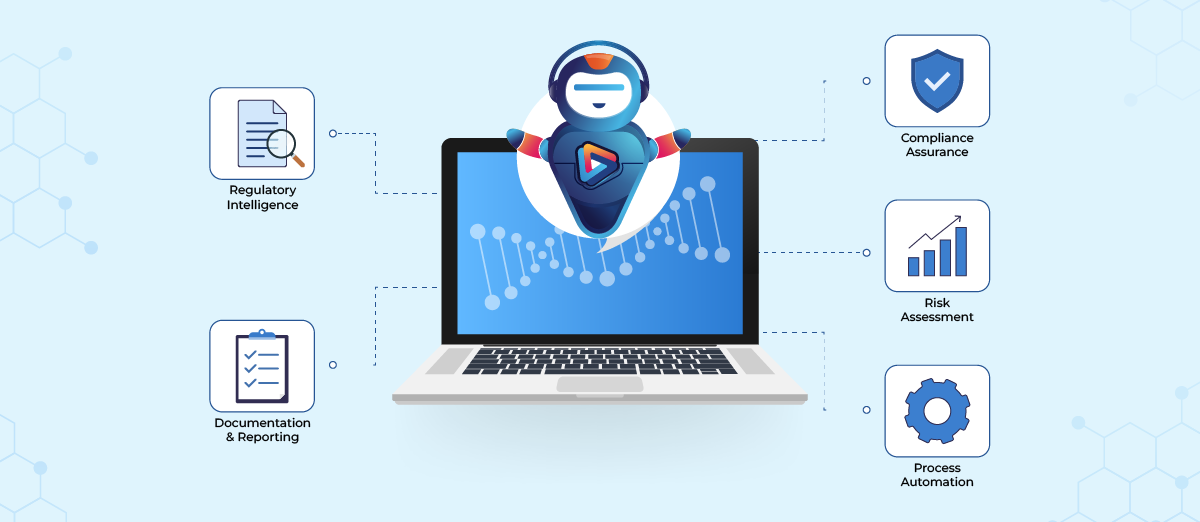
Artificial intelligence is already part of many life sciences workflows. But agentic AI in life sciences takes the conversation a step further. Instead of simply answering a question, summarizing a document, or generating text, an AI agent can work towards a defined goal, complete a series of connected tasks, use different tools and data sources, and recommend what should happen next.
For pharmaceutical and life sciences companies, this could have important implications. Regulatory teams monitor hundreds of changing requirements. Clinical and safety teams work with large volumes of data and documentation. Quality teams need to identify changes, assess their impact, and maintain traceability. R&D teams continuously review scientific evidence.
Agentic AI could help connect many of these activities. The important point, however, is that it should support, not replace the scientific and regulatory judgment of experienced professionals.
Agentic AI refers to AI systems that can work toward a defined objective with a higher degree of independence than traditional AI tools.
A conventional generative AI system usually waits for a prompt: you ask a question, and it produces an answer.
An agentic system goes further. For example, after being given a goal, it may break that goal into smaller tasks, retrieve information from approved sources, compare information, generate an output, check the result, and determine the next appropriate step.
This makes AI agents in life sciences particularly interesting because many life sciences activities are not single tasks. They are workflows.
Consider a regulatory change. Finding the new guidance is only the beginning. Someone then needs to understand what changed, identify affected products and markets, assess the impact, notify the right stakeholders, assign actions, update relevant documentation, and maintain an audit trail.
An agentic system could potentially support several of these steps as one connected process.
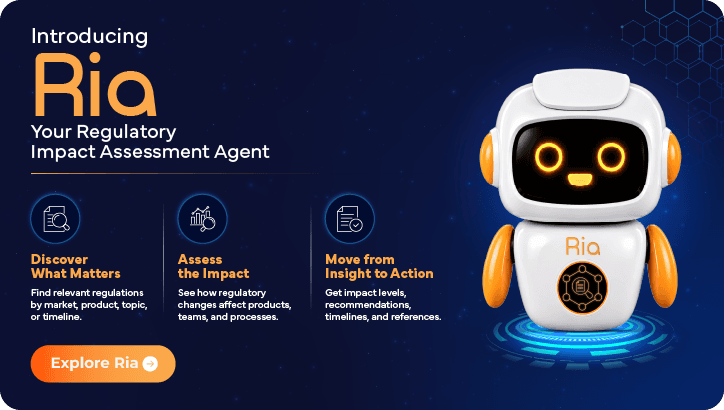
Our regulatory impact assessment agent does just that: See it in Action
However, in a highly regulated environment, important decisions still require appropriate human review, validation, accountability, and governance. This is always a non-negotiable.
Generative AI is very good at creating or transforming content. It can summarize a document, answer questions, translate text, compare information, or produce a first draft.
That already makes generative AI in pharma compliance valuable for activities such as document summarization, initial drafting, information retrieval, or simplifying complex regulatory information.
Agentic AI adds another layer: action and orchestration.
Instead of only saying, “Here is what changed in the regulation,” an agent could potentially be designed to:
That shift from generating an answer to supporting an end-to-end process is one reason intelligent automation in life sciences is gaining attention.
The value of agentic AI becomes clearer when we look at the work life sciences professionals perform every day.
Drug development requires scientists to work with enormous amounts of information: published literature, experimental data, clinical evidence, biomarkers, molecular data, previous studies, and internal research.
AI systems are already being explored for areas such as drug discovery, data analysis, biomarker identification, literature analysis, and hypothesis generation. A 2026 peer-reviewed review indexed by PubMed discusses the growing role of AI agents across areas including drug discovery, molecular design, biomarker discovery, and clinical optimization.
Agentic systems could make these capabilities more connected.
For example, one agent could search scientific literature, another could review experimental data, and another could compare findings with existing knowledge. Their outputs could then be combined into a structured recommendation for a scientist to evaluate.
The scientist remains responsible for determining whether the recommendation is scientifically meaningful.
Regulatory intelligence is one of the clearest potential applications of agentic AI in pharmaceuticals.
Regulatory professionals continuously track new regulations, guidance documents, safety communications, authority announcements, implementation deadlines, and changes across markets.
Traditional regulatory monitoring helps teams find information. AI-powered regulatory intelligence can go further by helping teams understand what that information means.
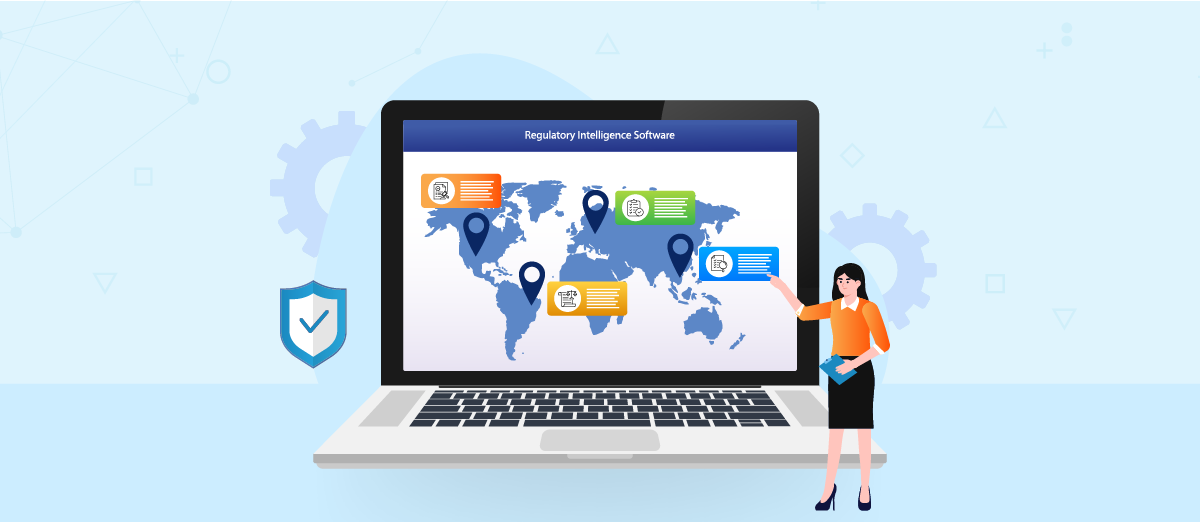
An agentic workflow could potentially connect regulatory monitoring with activities such as change detection, regulatory comparison, impact assessment, stakeholder notification, task assignment, and follow-up.
For example, rather than simply alerting a regulatory professional that a new health authority guidance has been published, an AI agent could help answer:
This is where AI-driven regulatory compliance becomes more meaningful. The objective is not simply to collect more regulatory information. It is to make that information easier to interpret and act upon.
Regulatory teams spend significant time collecting information from different sources and preparing documents.
Agentic AI could support activities such as gathering approved source information, preparing first drafts, checking documents against predefined requirements, comparing versions, identifying missing information, and routing drafts for expert review.
The EMA has already recognized potential applications of AI across the medicinal product lifecycle. Its reflection paper on the use of AI in the medicinal product lifecycle discusses applications ranging from drug discovery and clinical development to regulatory documentation and post-authorisation activities.
This does not mean AI should independently create a regulatory submission and send it to an authority.
A more realistic model for AI for pharmaceutical compliance is human-AI collaboration: AI handles repetitive information processing and first-pass preparation, while qualified professionals review the evidence, make decisions, and approve final outputs.
Quality and compliance workflows often involve repeatable but connected tasks.
A regulatory or quality change may require teams to identify affected SOPs, policies, specifications, training material, manufacturing processes, or controlled documents.
With appropriate controls, pharmaceutical compliance automation could help teams identify these connections more quickly.
An AI agent, for example, could review an approved regulatory change against internal documents, identify potentially affected content, prepare a gap summary, and create tasks for the responsible subject-matter experts.
What it should not do is independently decide that an organization is compliant.
Compliance conclusions depend on context, evidence, documented procedures, interpretation, and professional accountability.
Agentic systems may also support clinical development, pharmacovigilance, medical writing, safety monitoring, and labelling.
Potential applications include retrieving relevant evidence, organizing information, supporting document production, triaging information, monitoring commitments, or identifying records that require expert attention.
Again, the greatest opportunity is not removing people from these processes. It is reducing the time experts spend gathering, organizing, checking, and moving information so they can spend more time on interpretation and decision-making.
The potential of agentic AI is significant, but so are the risks.
Generative AI systems can produce incorrect or unsupported information. Their outputs can vary. Their performance depends heavily on the quality and relevance of the data they use.
In life sciences, the consequences of a poor-quality output can be particularly serious.
Organizations therefore need to consider issues including data quality, source reliability, privacy, security, bias, traceability, explainability, validation, accountability, and ongoing performance monitoring.
WHO has similarly emphasized responsible governance for AI in health. Its guidance on large multimodal AI models discusses governance considerations around the use of generative AI technologies in healthcare, scientific research, public health, and drug development.
These risks become even more important as systems become more agentic.
An incorrect answer from a chatbot is a problem. An incorrect answer that automatically triggers several downstream activities can become a much larger problem.
That is why greater autonomy should be matched by stronger governance.
The best starting point is not asking, “Where can we deploy an AI agent?”
A better question is: Which workflows are consuming expert time without making the best use of expert judgment?
That distinction matters.
Agentic AI works best when organizations first understand the workflow they want to improve. Automating a poorly designed process can simply make a bad process move faster.
Companies should therefore begin with clearly defined use cases, reliable data sources, measurable outcomes, and clear responsibilities for human review.
High-value opportunities may include regulatory monitoring, literature review, information triage, document comparison, first-pass impact assessments, structured drafting, commitment tracking, or workflow coordination.
The next step is defining boundaries.
What information can the agent access? What actions can it perform? When must it stop and request human approval? Which decisions must always remain with qualified personnel? What evidence and audit records must be retained?
These questions are just as important as selecting the underlying AI model.
There is a tendency to talk about agentic AI in life sciences as though the end goal is a system that can run entire processes on its own. That is probably not where the most useful applications will come from.
In practice, the better use case is likely to be narrower and more controlled. One agent may monitor regulatory updates. Another may compare a new requirement with existing internal information. A third may help prepare an initial summary for the regulatory team. The work can move faster, but someone still has to decide what the update actually means for the business.
That distinction matters.
A new regulation, for example, may affect one product but not another. It may apply differently across markets. An internal SOP may need to change, or it may not. Those decisions depend on context, and context is exactly where experienced regulatory professionals remain essential.
So, when we talk about autonomous AI in healthcare, the word “autonomous” needs some perspective. In a regulated environment, complete autonomy is neither realistic nor necessarily desirable. What companies are more likely to adopt are systems that can complete defined tasks independently but stop at points where expert review is needed.
That model is easier to trust and, just as importantly, easier to govern.
There is another point that often gets missed in discussions about agentic AI. Adding more AI does not automatically make a process better. If a workflow is already fragmented, poorly documented, or dependent on unreliable data, automation can simply make those problems move faster.
Before deploying agents, companies will need to look at the basics: data quality, ownership, validation, audit trails, access controls, and the points at which a human must step in.
For life sciences organizations, that may ultimately be the bigger change. The technology will keep improving, but companies will also have to rethink how work is structured around it.
The organizations that get the most value from agentic AI are unlikely to be the ones with the most AI tools. They are more likely to be the ones that know exactly where AI helps, where it does not, and where human judgment still needs to lead.
Agentic AI in life sciences is not simply another layer of automation.
Its real value is in helping teams deal with the volume and complexity of work that already exists across regulatory affairs, quality, safety, clinical operations, research, and compliance.
A regulatory professional should not have to spend hours looking through multiple sources just to understand whether something has changed. A safety team should not have to manually sort information that can be organized more efficiently. A quality team should be able to identify relevant changes without starting from scratch every time.
This is where AI-powered regulatory intelligence and agent-based workflows can make a practical difference.
But the technology still needs boundaries.
The final interpretation of a regulatory requirement, the decision to change a controlled process, or the approval of a compliance action cannot simply be handed over to an AI system without oversight.
That is particularly important for AI for pharmaceutical compliance, where decisions need to be traceable and defensible.
Over the next few years, the conversation will probably move away from “Can AI do this?” and toward a more useful question: “Where should AI be allowed to act, and where should a person remain in control?”
For life sciences companies, getting that balance right will matter far more than adopting AI quickly.
Agentic AI may reduce some of the manual work. It may help teams respond faster. It may even change the way certain regulatory workflows are designed.
But the expertise behind the final decision will still matter.
Want to see what that can look like in a real regulatory workflow?
Request a demo to see one of our AI agents in action.




Get your regulatory dose of information delivered straight to your inbox every month!
Subscribe Now