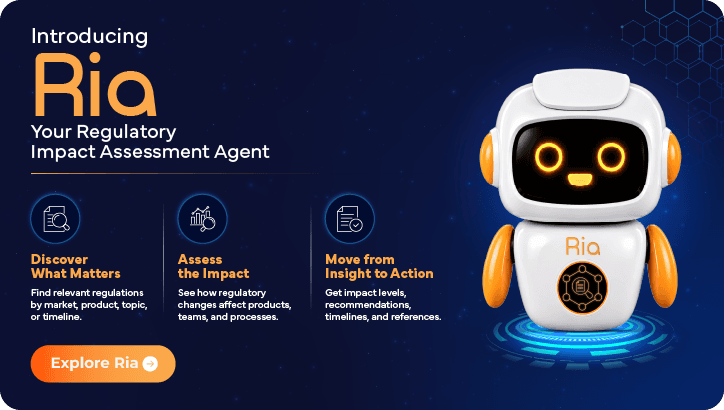
Your Regulatory Impact Assessment Agent for Turning Change into Action Watch Ria in Action
 July 9, 2026
A regulatory intelligence tool for life sciences earlier used to mean one thing: finding regulatory updates faster. That was useful, but limited. Regulatory teams today need more than alerts. They need context, relevance, traceability, and a practical way to decide what a new requirement means for products, markets, labels, submissions, quality processes, and so on.
The workload is only getting heavier. In 2024, the FDA’s CDER approved 50 novel drugs, while also making other approval decisions for new uses and broader patient populations. Each approval, label change, safety update, manufacturing change, and guidance revision creates downstream regulatory work for companies operating across markets.
That is where life sciences regulatory intelligence is changing. A modern regulatory intelligence platform helps teams understand what has changed, why it matters, who needs to act, and how quickly, in a nutshell.
At the most basic level, a regulatory intelligence software monitors health authority sources, guidance documents, regulations, notices, safety communications, standards, and policy updates across markets.
For global life sciences companies, regulatory monitoring must cover:
The real challenge is interpretation.
A regulatory update in one market may affect labeling. Another may change pharmacovigilance reporting. A third may affect CMC documentation or post-approval variation classification. A fourth may matter only if a product is marketed, active, and within a specific dosage form or route of administration.
Teams do not need more regulatory noise but rather they need need filtered intelligence.
Robust regulatory intelligence features help teams move from “something changed” to “this is what we should do next.” It should be able to support:
This is where many tools fall short. They provide databases, newsletters, or keyword alerts. Rarely sufficient.
Regulatory teams need a system that connects external regulatory change with internal business relevance. A new guideline does not matter equally to every company. Even within the same company, it may matter differently across products, dosage forms, licenses, manufacturing sites, and markets. That is why the to actionable intelligence really matters.
A global regulatory intelligence program becomes valuable when it improves decisions. The most important decision is usually simple to ask and difficult to answer: does this change affect us?
A good regulatory impact assessment workflow helps teams answer that question with discipline. It helos users evaluate:
This is particularly important in post-approval environments. Once a product is approved, the company’s regulatory obligations continue for years. Manufacturing changes, supplier changes, labeling updates, safety signals, market withdrawals, renewals, and administrative changes can all trigger different regulatory pathways.
In the EU, for example, pharmaceutical legislation has been undergoing major reform. The European Commission noted in December 2025 that the EU had reached a political agreement to update its 20-year-old pharmaceutical rules, with goals including streamlined procedures, faster access, innovation incentives, and stronger monitoring of medicine shortages.
For companies, that kind of reform creates practical questions. Which rules change? Which markets move first? Which submissions are affected? Which internal SOPs need review? Which teams need to prepare?
That is the true operational value of a regulatory intelligence platform. It helps companies avoid treating regulatory change as a reading exercise and starts treating it as a managed business process.
AI in regulatory intelligence is becoming one of the most important shifts in regulatory operations. Early use cases were straightforward: search faster, summarize longer documents, translate content, and answer questions from regulatory sources.
Those use cases still matter. A regulatory chatbot can save hours when teams need to query guidance documents, compare requirements, or understand a new health authority update. We think that the bigger opportunity is reasoning.
The FDA’s own AI-enabled medical device list shows how quickly AI has become part of the regulated product landscape. The agency says the list identifies AI-enabled devices authorized for marketing in the United States, and that the listed devices have met applicable premarket requirements, including review of safety and effectiveness. The list is current as of June 16, 2026. Regulators are also adapting their own approaches to data and digital evidence. EMA’s work on big data and regulatory decision-making reflects a broader movement toward using larger, more diverse data sources in medicine evaluation and supervision.
For regulatory affairs teams, AI should not be judged by whether it can produce a neat summary. That is table stakes. The better question is whether AI can help regulatory professionals reason through uncertainty while preserving evidence, source traceability, and human oversight.
Our Expert Take: The Risk Is Shallow AI.
Many regulatory teams are cautious about AI, and rightly so. A confident but unsupported answer can create more risk than a slow manual process.
But the bigger issue is shallow AI adoption. If companies use AI only as a document summarizer, they will get efficiency at the surface and leave the real bottleneck untouched. Regulatory work is is slowed down by interpretation, cross-functional alignment, product-specific applicability, market variation, and defensible decision-making.
The next phase that is the introduction of agentic AI in life sciences should focus on governed reasoning. That means AI agents should go beyond respond to questions, to actually follow structured regulatory logic, consult verified sources, work within defined workflows, flag ambiguity, and show why an answer was reached.
One of the use cases of agentic AI that we think is in Post-approval change management. It is one of the clearest areas where agentic AI can create measuable value.
Why you ask? Because the work is rule-heavy, context-dependent, repetitive, and still too important to leave to automation without oversight.
A single post-approval change may require teams to determine:
In environments like these, a generic chatbot is not enough. A post-approval change decision needs product context, market context, regulatory logic, and source-backed reasoning.
This is where agentic AI becomes more meaningful. However, we also think that the best systems will still keep humans in the loop. That is a strength, not a limitation. Regulatory accountability remains with the organization. AI should help professionals move faster with better evidence, not remove expert judgment from high-stakes decisions.
A modern regulatory intelligence tool for life sciences should help companies move from global monitoring to regulatory action. That is the direction Freyr is building toward with freya and eventually our Agentic Fleet.
freya is our AI-powered regulatory intelligence chatbot, designed to help regulatory teams interact with regulatory information more naturally. Instead of manually combing through long documents or scattered updates, users can ask questions, explore guidance, retrieve relevant intelligence, and get faster support for day-to-day regulatory research.
For teams that want to experience this shift firsthand, freya can be explored through a 14-days free trial. It is a practical way to see how AI can support regulatory research, monitoring, and intelligence workflows without forcing teams into a heavy implementation from day one.
Sign up for our FREE 14 days trial
Alternatively, get a personalised demo from our experts to see how Freyr can help your teams move from regulatory updates to regulatory action.




Get your regulatory dose of information delivered straight to your inbox every month!
Subscribe Now