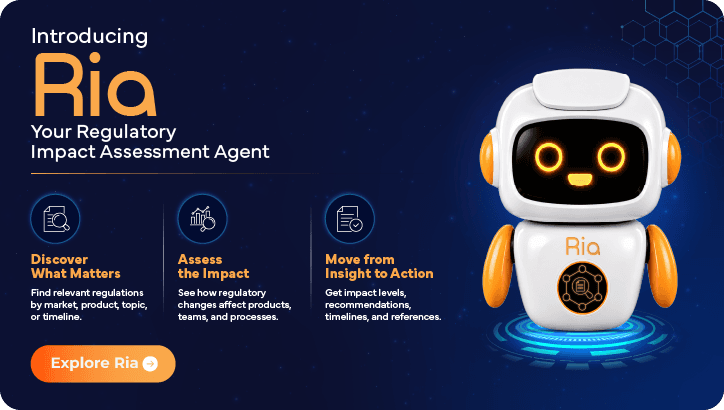
Your Regulatory Impact Assessment Agent for Turning Change into Action Watch Ria in Action
 November 11, 2026

Regulatory Intelligence is the practice of tracking regulations, guidance, standards and competitor activity, then working out what each change means for your products, markets and processes so the right people can assess the impact, decide and act, with a clear record of what was done. That is how it supports better decisions: an alert is where the work begins, not where it ends.
Regulatory teams today are not short of information. New regulations, guidance documents, standards, safety communications, label changes and competitor moves arrive every day from markets around the world. The harder part begins once a signal has been spotted. Is it relevant to us? Which products, markets, registrations or documents does it touch? What gaps or risks need checking, who should review it, and how do we track the resulting action so someone is clearly accountable?
These questions formed the basis of our recent live session, When a Signal Is Only the Beginning: Operationalizing Regulatory Intelligence. The discussion brought together Freyr’s innovation and product leaders with regulatory and compliance practitioners from AMETEK Reichert to examine how Regulatory Intelligence needs to evolve.
One conclusion emerged consistently: the future of Regulatory Intelligence will be defined by how effectively organizations convert external change into relevant insight, coordinated assessment and informed action.
Traditional models focused mostly on watching external sources and passing updates to regulatory teams. That still matters but the setting around it has become a lot more complicated. One development can mean different things depending on a company’s portfolio, target markets, registrations, manufacturing sites and internal processes. Even inside a single company, Regulatory Affairs, Quality, CMC, Pharmacovigilance and Labelling may each read the same development differently.
The medical-device perspectives from the session made this concrete. A product change that looks simple may have to be checked against health authority requirements, software guidance, wireless communication standards, metrology rules and country-specific registration conditions.
Forwarding an alert rarely gives a team enough context to act. They need help working out what the change means for them, and support for what happens next.
Four shifts can make that possible.
Wide global coverage still counts, but the value comes from relevance. That depends on organizational context: products, ingredients, therapeutic areas, device classes, markets, registrations, manufacturing locations and business priorities. It also depends on who is reading. A Quality professional, a CMC specialist and a pharmacovigilance expert can support the same portfolio and still need different information.
So, personalization of regulatory information has to work at three levels: the organization and its portfolio, individual departments and functions, and the responsibilities of each user. To do that, a system needs to understand industry terminology as well as a company’s own labels and structure, for example internal tags for strategic products, priority markets or risk levels.
Prioritization should be explainable too. People need to see why a signal was marked relevant or urgent, not just receive another score. The goal is to get the right signal to the right person at the right time, with enough context to take the next step.
Spotting a relevant development kicks off a much bigger process. Someone has to judge the impact. Requirements may need comparing against procedures, dossiers, labels or technical documentation. Gaps have to be found, specialists consulted, actions agreed. Because this crosses functions, systems and sites, teams often end up duplicating assessments, losing track of owners, missing stakeholders and having little visibility on whether anything actually got closed.
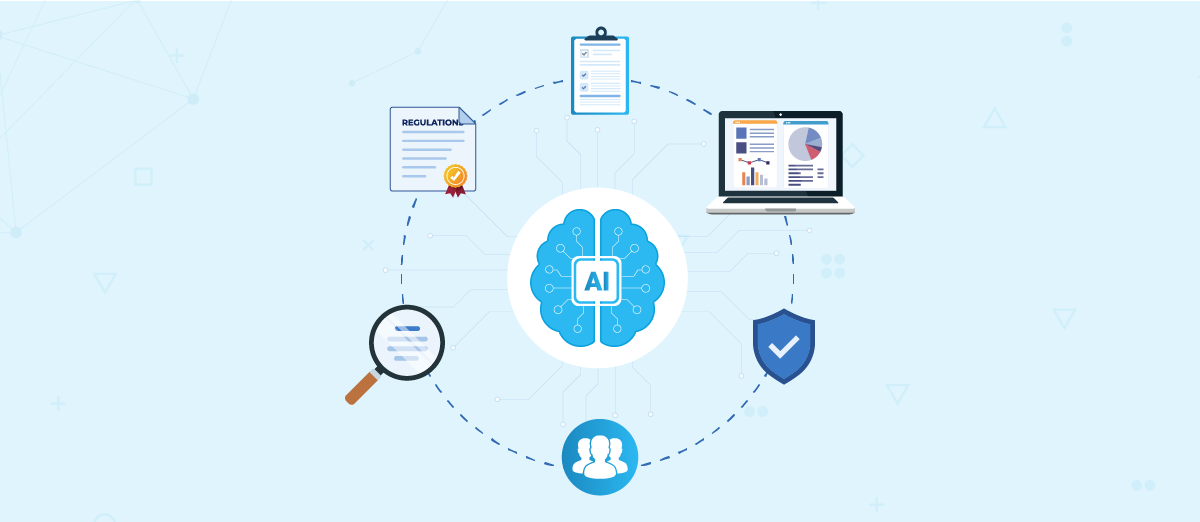
A connected regulatory intelligence workflow can fix much of this, and AI can prepare the ground for expert review. It should be able to draft a first regulatory impact assessment, flag the products, markets or documents that may be affected, pull up supporting internal and external evidence, route the work to the right experts, suggest actions based on rules or past precedents, and record comments, decisions, approvals and status changes.
The key point is that AI prepares and the regulatory expert decides.
Traceability matters just as much: a record of what the system recommended, what evidence it used, who reviewed it, and whether the recommendation was accepted, changed or rejected. That gives regulatory change management a clear path from external change to assessment, ownership and closure, instead of leaving each update sitting alone in a monitoring tool.
Regulatory organizations lean heavily on experienced subject-matter experts, and what those people know goes well beyond any procedure or database. They know which questions to ask, which exceptions to look for, how requirements connect and what evidence they need before reaching a conclusion. Much of that reasoning stays in people’s heads and is hard to scale.
Some of the repeatable parts can be turned into “digital SMEs”: specialized agents built around one defined regulatory activity. They follow decision pathways set by the SMEs, check relevant sources, compare requirements and prepare a first analysis. Examples include comparing dossiers or controlled documents, reviewing regional labelling requirements, spotting SOPs that may be affected, tracking changes across health authorities, supporting recurring change assessments, and preparing information for registration or lifecycle work.
This doesn’t mean automating every expert judgment. Regulatory work is full of exceptions, ambiguity and business context that need a human. The gain is that digital support handles the repeatable preparation and analysis while specialists spend their time on exceptions, risk and strategy. It also keeps institutional knowledge in use, so good reasoning gets reused instead of rebuilt for every assessment.
Plenty of regulatory questions can’t be settled by reading one regulation. A post-approval change for instance might involve product data, approved registrations, market-specific requirements, the proposed change, regulatory commitments and the submission documents. A market-entry or indication decision could draw on clinical trial intelligence, competitor activity, approved labels and internal development data. You can’t answer either well without connected internal and external intelligence.
In the session we discussed a model where specialized agents each take a piece of the question. One goes through the organization’s product or registration data. Others look at external requirements, labels, clinical trials or competitors. Their findings are cross-checked and put together for an expert to weigh.
One rule sits underneath all of this: a lack of information is not evidence. A well-built system notices an unanswered question, returns to the source with a sharper query and flags any data gap that remains. A general-purpose AI model won’t do that on its own. It takes granular, structured, verifiable data and reasoning paths written by regulatory experts. The recommendation that comes out should show which evidence was used, which connections were made and what limits remain. In high-stakes regulatory work, explainability and traceability are part of the answer itself.
Three things came up in every part of the discussion.
The first is connected, verifiable data. AI can only work with what it is given, and fragmented, outdated or badly structured data limits even very capable technology. Trusted external regulatory information has to sit next to accurate internal context, meaning products, registrations, markets, documents, ingredients and changes in progress. The two need to be linked if the output is going to be specific to the organization.
The second is reasoning defined by SMEs. AI can connect and process knowledge, but the logic behind regulatory work has to come from experts. They decide which questions matter, how requirements relate, what conditions and exceptions apply and what evidence is enough. That logic gives specialized agents their purpose and keeps them from drawing conclusions nothing supports.
The third is human review and accountability. AI can search, compare, summarize, flag potential gaps and prepare assessments. Responsibility for the decision stays with regulatory professionals, so organizations need clear review steps, governance and decision rights around any AI-supported work. The aim is a better-informed expert who keeps control of consequential decisions.
With freya.intelligence we’re building toward a single connected ecosystem that covers the whole journey: detecting a change, understanding why it’s relevant, assessing impact and supporting the action. It is meant to handle broad monitoring, research, personalization and exploration across global regulatory sources, so organizations can see what is shifting and pick out what deserves attention.
Some scenarios need a precise, traceable answer, and for those we have the Granular Regulatory Requirements (GRR) module. It applies expert-curated, structured intelligence and specialized reasoning to high-stakes cases where a deterministic response is required. The two capabilities complement each other. One watches the horizon and explores context; the other covers defined scenarios where certainty, consistency and defensibility matter most.
We’re also connecting these models to regulatory impact assessment, organizational workflows, knowledge graphs and specialized digital agents, so that regulatory teams can move from awareness to assessment, decision and coordinated action.
No organization has to introduce AI everywhere at once. Pick the process that causes the most friction. It could be the volume of irrelevant updates, slow impact assessments, trouble routing work, document comparisons done again and again, or reliance on a few experts. Then work through five questions:
Starting this way ties the technology to a real regulatory need and makes the path from pilot to adoption easier to see.
Watch the LinkedIn Live recording to revisit the full discussion. To explore how these ideas could apply within your organization, speak with our team or write to us at sales@freyrregintel.com.


Get your regulatory dose of information delivered straight to your inbox every month!
Subscribe Now