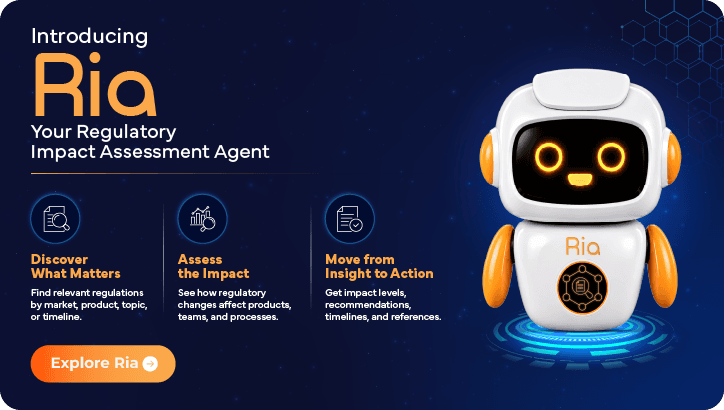
Your Regulatory Impact Assessment Agent for Turning Change into Action Watch Ria in Action
 June 26, 2026
In 2026, both the EU and the US regulatory bodies have passed legislation or are proposing changes that are of crucial importance to the life sciences industry. This also includes cosmetics and medical devices. These pharmaceutical regulatory updates 2026 run the gamut from digitalization, patient access, prior information, and Bayesian inference.
As a company, be mindful of how digitalization will streamline your interaction with the regulatory process. Also, learn about how the application of Bayesian inferential approach will modify drug assessment, leading to its ramifications of market penetration. Furthermore, keep in mind that prior knowledge is now changing drug development, from a time-sensitivity standpoint. This aforementioned prior knowledge is expert-approved.
Finally, MoCRA is bringing facility registration, unique and active product listings into sharp focus. Know that much more stringent compliance screenings are being instituted, including those that involve customs.
The EU Parliament just passed legislation that will be of salience to companies trying to enter that market. This is known as the “EU pharmaceutical legislation”. The major facets of this new set of laws are modernizing how drug development, authorization and availability are regulated and overseen. The goal is to prioritize innovation, assess EMA’s committee structure with an eye towards the science, shortages with respect to the medication and sustaining the environment.
Bear in mind that the main issues being addressed with regards to this new legislative framework involve the intersection of regulations and innovative ambitions, making patient accessibility a priority, and attending to public health problems like AMR, antimicrobial resistance. Moreover, digitalization, complexity reduction that affect developers and making network sustainability more robust when it comes to administration are also of vital significance. The last one is particularly important to efficiently harness resources that evaluate the science and make the assessment of products, especially complex ones, more nimble.
Across the Atlantic, the US FDA is now proposing permitting organizations that specialize in cellular and genetic therapies to use prior knowledge. This change in recommendation involves the utilization of data of various kinds. This includes nonclinical and clinical knowledge, chemistry information, and data with respect to manufacturing and controls. The prior information is expert-accepted and was acquired from the development of similar products, in the past. This is according to the FDA.
Again, the goal here is to expedite development. Earlier this year, the same agency had proposed newer frameworks when it came to approvals of personalized treatment in the world of uncommon genetic maladies. They proposed using well-controlled studies, usually smaller in scale, as opposed to traditional trials.
Finally, in the US, the FDA has put out a draft guidance that substitutes old-fashioned frequentist clinical efficacy methods with Bayesian methodologies in evaluating drugs to gauge whether market authorization is feasible. Bayesian inferential frameworks are considered more coherent when it comes to integrating analytical, pharmacokinetic, clinical data and evidence. This will have broader implications for harmonization when it comes to global pharmaceutical regulations.
In 2022, MoCRA was passed. Now, this piece of legislation, full form, ‘Modernization of Cosmetics Regulation Act of 2022’, expands the authority of the Food and Drug Administration, widens the obligatory nature of the industry itself, reforms the monitoring, marketing and shelf-removal of cosmetics.
Firstly, compulsory registration and the listing of the cosmetic products is being instituted. This includes ingredient information, manufacturing data. In January of this year, 14,299 facility registrations and 992,907 product listings have come into fruition. These are unique and active. This provides the regulatory body with more oversight into manufacturing, including location. There will be stricter enforcement if the product listings do not meet the standards. This will delay imported products, because random compliance screenings, in collaboration with the Customs and Border Patrol, are now the norm.
Secondly, the FDA, according to the new regulation, can now withdraw cosmetics, if they are proven to not be up to the standards. This is referred to as mandating recalls. This is especially applicable to products that misbrand, evince adulteration, cause serious health issues. A draft guidance was issued last year when it came to this. Once the draft guidance is made final, the new protocol will mandate industry cooperation with regards to the FDA’s power of recall. This also involves internal mechanisms of review and recall, to comply with the FDA’s new expectations.
Thirdly, maintenance of records by the manufacturer, packer and distributor of cosmetics, when it comes to safety substantiation is now a cornerstone of emerging regulatory behavior, in this arena. This new protocol is referred to as ‘Adequate Substantiation of safety’ and it involves the testing, analyses and expert studies that testify to the safety of a product.
Coming back to the EU, when it comes to cosmetics, it’s important to remember, new prohibitions have been instituted, according to Commission Regulation (EU)202/909. The SCCS, Scientific Committee on Consumer Safety, and its evaluations are now reflected in this amendment. This is in reference to concentration limits that have been revised, controls for impurities and reclassifications. This new regulation is now being enforced, beginning in May of 2026.
The FDA has updated certain guidance protocols when it comes to medical devices. The title of this guidance document is “Cybersecurity in Medical Devices: Quality System Considerations and Content of Premarket Submissions – Guidance for Industry and Food and Drug Administration Staff”. This is in reference to the mitigation of risks as relates to medical device connection to wireless and network technologies.
The main facets of this guidance is the assessment of cybersecurity controls that manufacturers need to oversee, and they are being identified at the premarket submission stage. These include secure architecture, cybersecurity risk and threat evaluation and modeling, protection of data confidentiality, data integrity, ensuring that only authorized people can access the device in terms of functionality, strong emphasis on encryption and detection of events. The guidance also requires manufacturers to test for cybersecurity vulnerabilities and software transparency is given salience.
For the EU changes, bear in mind that there will now be two committees overseeing the science, when it comes to medicines, for humans. One of these committees is known as Committee for Human Medicinal Products. The other, Pharmacovigilance Risk Assessment Committee. Now, this will make things easier for the private sector by cutting down assessment time. Scientific tools and resources medicine manufacturers need will be more readily available.
Secondly, according to the new rules, marketing authorization is now automatically validated for an indefinite time, with the caveat of safety issues, as directed by the EMA’s scientific groups. Also, applicants can now give in digitally structured applications to enable market authorization. In fact, they are required to do so. These shifts are closely tied to evolving EMA pharmaceutical guidelines and the broader direction of drug approval regulations.
When it comes to the FDA’s new guidance draft regarding the utilization of Bayesian analysis, its implications for global harmonization are manifold. They lead to what is known as assumption transparency. This is basically regulators being given the opportunity to re-assess underlying assumptive parameters and specifics when it comes to prior information. They can also ask for sensitivity analyses to re-examine prior information, according to their own standards of proof, irrespective of jurisdiction. This is due to the distinction that Bayesian approaches needing to have explicit specifying of prior information, as opposed to the older frequentist analytical frameworks. Convergence between different bodies like the FDA, the PMDA and the EMA, on the use of regulatory documentation and submission that take into account Bayesian analytics will enhance the mitigation of cost and complexity for pharmaceutical programs, globally.
With regards to MoCRA, pay close attention to the FAERS, FDA Adverse Event Reporting System. This system is basically a public dashboard, that enables the public to access adverse event information, with respect to cosmetics. Consumers, salon staff, health care workforce and providers, lawyers, those in retail and investors can now find themselves empowered by ready visibility to this type of knowledge. You, the manufacturer, can track investigations, evolving trends and even internal processes when it comes to your own products, that of your competitors and the industry, in general.
Also, as far as the EU is concerned, there have been amendment proposals to Regulation (EU) 2017/745 on medical devices, MDR, and Regulation (EU) 2017/746, the latter regarding in vitro diagnostic medical devices or IVDR. The reforms and amendments concentrate on simplification of regulations, lessening of administrative pressures and making the conformity assessment process more efficient. This is still at a proposal stage, so keep an eye on it.
As a conglomerate you need to be on top of the FDA’s guidance in terms of the medical devices cybersecurity controls and safety measures. Also, try to learn and upskill your workforce as regards to how the medicinal scientific committee changes, EU-wise, will benefit assessment time. Keep a sharp eye on the digital aspects of market authorization submissions.
In 2026, companies like yours that specialize in drug development, medical devices and cosmetics need to keep tabs on everything from the use of Bayesian analyses to dashboards that monitor adverse events. It’s a big task, and is linked to the life sciences regulatory climate this year and the corresponding balance between market entry management and pharmaceutical regulatory compliance, that you need to strike.
Regulatory changes in 2026 are not limited to one market, one product category, or one function. From EU pharmaceutical legislation and FDA guidance shifts to MoCRA enforcement and medical device cybersecurity expectations, organizations need more than awareness. They need clear interpretation, practical impact assessment, and expert-led regulatory action plans to keep pace with changing Pharmaceutical Industry Regulations.
Our regulatory consulting experts help life sciences, medical device, and consumer healthcare companies understand what changing regulations mean for their products, markets, submissions, and compliance strategy. Whether you are preparing for new requirements, assessing regulatory impact, or planning market entry, our experts can help you move forward with confidence.
Need clarity on how these regulatory changes may affect your business?
Book a meeting with a Freyr regulatory expert to discuss your compliance priorities and next steps.




Get your regulatory dose of information delivered straight to your inbox every month!
Subscribe Now