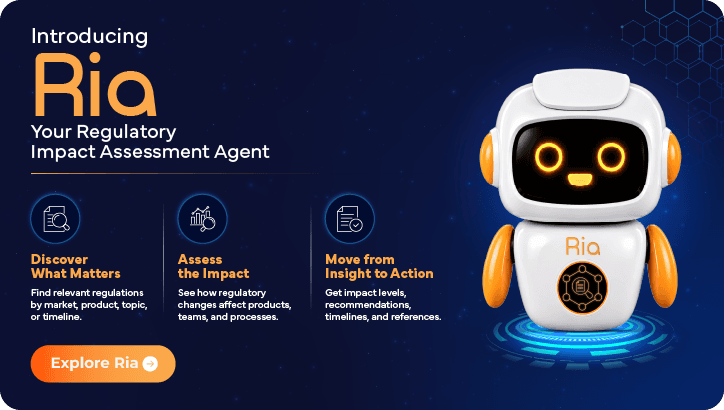
Your Regulatory Impact Assessment Agent for Turning Change into Action Watch Ria in Action
 May 6, 2026
Regulatory change is constant. That is the operating reality for every pharmaceutical company with a global footprint. Between shifting ICH guidelines, region-specific submissions requirements, post-Brexit MHRA divergence from EMA, and the U.S. FDA’s rolling guidance updates, the volume of regulatory signals that a mid-to-large pharma organization must track, interpret, and act on has grown substantially. Global regulatory change management has become a core strategic capability and the companies treating it as such are pulling ahead.
This piece is for regulatory affairs leaders, compliance heads, and the people sitting in the uncomfortable middle: responsible for everything, resourced for much less.
Here is an uncomfortable truth: a significant portion of the industry still manages regulatory changes through spreadsheets, shared drives, and email threads with subject lines like “FW: FW: RE: New EMA guidance, action needed?”
The data backs this up. According to a survey, nearly 48% of regulatory professionals reported that their organizations lacked a formalized process for tracking and operationalizing regulatory changes. That is not a technology gap, it is a structural one.
What makes regulatory change management in pharma genuinely hard is not the volume of changes themselves. It is the downstream complexity. A single update to an ICH Q3D guideline on elemental impurities, for instance, does not just affect your analytical team. It may touch your CMC documentation, your supplier qualification process, your registered specifications in multiple markets, and your ongoing stability studies. The change is one line in a guidance document. The organizational response can be 40 tasks across six functions.
Most regulatory teams are not set up to map that cascade. They track the change. They may even log it somewhere. But connecting regulatory signal to operational impact at scale, across markets is where the system breaks down.
Regulatory intelligence is the starting point, but it is also the most poorly implemented piece. Many organizations subscribe to regulatory alert services and then route everything to one or two people who become de facto filters – overwhelmed, under-resourced, and inevitably creating bottlenecks.
Effective global regulatory change tracking requires a tiered distribution model:
The mistake most organizations make is treating regulatory intelligence as a single information feed rather than a routed, role-specific one. The volume problem people complain about is often actually a routing problem.
Most regulatory teams conduct impact assessments reactively, after a change has been published, a deadline is approaching, or an inspection is imminent. The better approach, which fewer than a third of companies actually have operational, is a prospective impact framework that flags likely changes 12-18 months before they become binding. Agencies publish advance notices. Draft guidances exist. ICH working groups publish their work plans. There is no shortage of early signal, the issue is that most organizations are not systematically watching for it.
A mature impact assessment process for managing regulatory changes should answer four questions quickly:
If your current process cannot answer those four questions within 72 hours of a guidance publication, you have a process gap worth addressing.
This is where a lot of well-designed processes fall apart in practice. Regulatory affairs identifies the change, conducts the impact assessment, and then… waits. Or sends an email. Or schedules a meeting that gets deprioritized because the commercial team has a product launch happening.
Pharma regulatory compliance changes require true cross-functional ownership, which means regulatory affairs cannot be both the monitor and the accountable party for execution. The monitor role belongs to reg affairs. The execution ownership must sit with the function that has to do the actual work quality, medical affairs, manufacturing, whichever is relevant.
This requires a governance structure, not just good intentions. Many companies underinvest here. They build elegant regulatory change tracking systems and then route everything back to a team of four people to “manage.”
Compliance change management in pharma is not complete when a change is identified and communicated. It is complete when the relevant documentation, processes, and submissions have been updated, and when someone can demonstrate that during an inspection.
The audit trail matters. Inspectors from FDA, EMA, and MHRA are increasingly asking for evidence not just that you were aware of a regulatory change, but that you assessed it, made a deliberate decision, and executed accordingly. “We track it in a spreadsheet” is not an answer that lands well.
A closed-loop system needs:
The market for regulatory monitoring tools has grown substantially over the past five years, and the quality variance is enormous. Some platforms are essentially curated news feeds with a database behind them. Others offer genuine workflow integration, connecting regulatory signals to affected dossiers, generating task assignments, and maintaining audit trails.
There is a tendency in pharma to over-invest in the intelligence layer and under-invest in the workflow layer. Companies will spend considerable budget on a regulatory intelligence platform that gives them comprehensive coverage of global agency outputs, but then use email to manage the actual response process. The result is an organization that is very well-informed about changes it is not properly acting on. The intelligence is necessary but not sufficient.
When evaluating a regulatory intelligence for change management solution, the questions that actually matter are:
Coverage breadth is table stakes. The differentiating factor is what the tool helps you do with the information, not just what it shows you.
There is a pervasive assumption in the industry that regulatory compliance is fundamentally a cost center. That framing leads to chronic under-resourcing. But consider the actual risk calculus: a failed inspection, a consent decree, a product recall triggered by a missed regulatory change, these carry costs that dwarf any investment in a robust pharmaceutical compliance strategy. The regulatory function is not overhead. It is risk management infrastructure, and it should be budgeted accordingly.
A mature compliance strategy for regulatory updates tracking across global markets should include:
The last point is underutilized. Most organizations measure regulatory intelligence by coverage. The smarter measure is cycle time: how long from identification to completed organizational response.
This is exactly where freya.intelligence comes in. freya.intelligence is an AI-powered regulatory intelligence platform built specifically for pharma and life sciences teams managing the complexity of global regulatory change management across multiple markets and agencies.
It monitors regulatory outputs from FDA, EMA, MHRA, CDSCO, TGA, Health Canada, ANVISA, and 40+ other agencies, and does not just surface changes, but helps you assess impact, assign ownership, and track resolution. It is the difference between a team that knows what changed and a team that knows what to do about it.
You can take freya for a test drive with a 14-day free trial, no commitment, no lengthy onboarding. If your current process for tracking and acting on regulatory changes has gaps (and most do), it is worth 14 days to see what a purpose-built solution actually looks like in practice.
The regulatory environment is not getting simpler. The agencies are not slowing down. And the inspectors asking hard questions about your change management process are not going away. Global regulatory change management is the capability that separates organizations that are genuinely compliant from organizations that are hoping to be.
The gap between those two groups is smaller than most people think, and entirely closeable.




Get your regulatory dose of information delivered straight to your inbox every month!
Subscribe Now