Your Regulatory Impact Assessment Agent for Turning Change into Action Watch Ria in Action
 April 9, 2026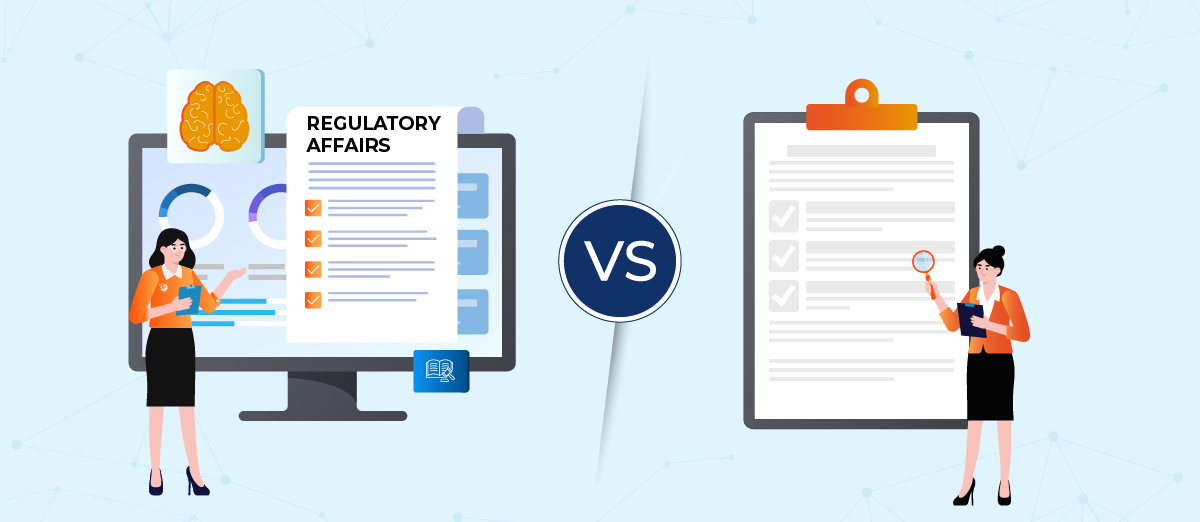
Regulatory Intelligence or Manual Tracking: Which One Is Actually Keeping Your Team Afloat?
We have heard of enough regulatory team meetings to know what burnout looks like before anyone names it. It looks like a senior RA manager pulling up a spreadsheet she built three years ago, scrolling through 400 rows of color-coded agency alerts, and sighing before she even starts. It looks like a junior associate assigned to “monitor” seven agency websites every morning like it is a perfectly reasonable job function.
The debate around Regulatory Intelligence vs manual tracking has been simmering for years. At this point, for any company operating across more than two or three markets, it has moved well past debate – especially after AI became more than a buzzword.
Nobody set out to build a broken system. The spreadsheets, the shared drives, the agency alert email chains, these things made sense when the regulatory landscape was simpler and the volume of published guidance was something a small team could actually keep up with. That world is gone.
The FDA alone issued over 1,200 guidance documents and regulatory notices in 2023. Add EMA outputs across 27 member states, PMDA, ANVISA, Health Canada, MHRA, TGA and you are asking your team to drink from a firehose while simultaneously writing submission strategy memos and managing label negotiations.
RAPS benchmarking has put the average cost of a major regulatory compliance event at $14.82 million. That figure sticks in my mind because it represents the kind of outcome that manual processes make more likely every single quarter they stay in place.
So What Does Regulatory Intelligence Actually Do?
The term gets thrown around loosely, so we want to be specific about what separates genuine automated Regulatory Intelligence from what a lot of vendors are actually selling.
A real Regulatory Intelligence platform does not just aggregate. Any RSS feed can do that. What it does is monitor continuously, interpret contextually, and surface what is relevant to your portfolio and your markets, not just what was published today across every agency on earth. The distinction sounds minor. Operationally, it is enormous.
There is a category of tool I think of as “compliance theater.” It gives teams a dashboard full of regulatory updates, earns a checkbox in the procurement review, and then requires the same manual filtering and reading the team was doing before just with a prettier interface. That is not Regulatory Intelligence. That is an aggregator with an annual license fee.
Genuine regulatory monitoring tools built around AI and natural language processing do a few things manual processes structurally cannot:
The Cost Arithmetic Nobody Wants to Do
Lets walkthrough a number that tends to land differently when people see it written out.
A mid-size specialty pharma company with a global portfolio typically dedicates three to five FTEs to regulatory tracking and monitoring. At fully loaded costs like salary, benefits, management overhead, tools they already pay for, that is somewhere between $450,000 and $900,000 a year. And that estimate does not include errors. It does not include the opportunity cost of those people not doing regulatory strategy, not working on submissions, not contributing to the higher-value work the organization actually hired them for.
Enterprise compliance monitoring systems with genuine AI capability typically run $80,000 to $250,000 annually for mid-size companies (Learn about costing here). The math on manual vs automated regulatory tracking is not particularly close. What makes it close in practice is the switching cost, the change management effort, and the very human tendency to underestimate what the status quo is actually costing.
Here is something we believe that does not always go over well when we say it to leadership teams: the fact that your manual tracking process has not visibly failed is not evidence that it is working. In most cases, it is evidence that your regulatory staff are extraordinary people who are quietly absorbing an unreasonable amount of operational dysfunction so that the organization does not have to face it.
We have seen this pattern repeatedly. A team runs on personal expertise, individual heroics, and institutional memory. Then someone retires or leaves. And suddenly the organization discovers that the “system” was actually a person and that person took years of hard-won knowledge with them. This is one of the real, underappreciated risks of manual regulatory tracking that never shows up in an audit finding.
AI in regulatory affairs has matured considerably in the past three to four years. The honest picture now is more interesting and more useful than either the hype or the backlash suggested.
What machine learning and NLP handle well in regulatory contexts is the high-volume, high-consistency work that human attention is genuinely bad at maintaining over time. Reading several thousand regulatory documents a month. Detecting whether a specific change to EMA pharmacovigilance guidance is relevant to a company’s oncology portfolio versus its rare disease assets. Flagging a shift in FDA’s language around a particular submission type that might indicate a policy evolution. These are pattern-recognition tasks at scale. Computers are better at them than people.
What AI does not replace is regulatory judgment. The decision about how to respond to an agency signal, how to position a submission, how to navigate a complex multi-stakeholder review, that remains deeply human work. The best AI in regulatory affairs implementations we have seen are ones where the technology handles the upstream noise so the humans can focus entirely on the downstream thinking.
But here is the thing about regulatory workflow efficiency that vendors tend to gloss over. Deploying a better monitoring tool does not automatically make your regulatory operations more effective. It moves the bottleneck.
Before automation: the bottleneck is finding relevant information. After automation: the bottleneck is routing it to the right person and getting a decision made in time.
Companies that invest in sophisticated compliance tracking methods without simultaneously redesigning how intelligence flows through their organization often find that they have paid a significant license fee to surface problems faster without actually solving them faster. The technology is necessary. It is not sufficient. You need clear ownership of regulatory signals, defined escalation protocols, and a cross-functional review cadence that makes use of what the system is surfacing. Otherwise you have just built a faster way to fill up someone’s ignored notification queue.
The assumption that Regulatory Intelligence platforms are enterprise pharma tools for large companies with large budgets is outdated, and it is causing real harm at the smaller end of the market.
A small biotech with two pipeline assets in four markets has proportionally more to lose from a missed regulatory signal than a company with fifty products. One misstep on an accelerated approval pathway, one missed shift in submission format requirements for a priority market can set a program back six to twelve months. For a company at that stage, twelve months is not an inconvenience. It is a fundraising cycle, a partnership negotiation, sometimes an existential question.
The “we are too small for this” assumption deserves to be re-examined by anyone who last checked three or more years ago.
Not every company should make this transition on the same timeline. Here is how I think about it:
Continue with enhanced manual processes if:
The Regulatory Intelligence vs manual tracking question ultimately reduces to this: what is the actual cost of your current approach, fully loaded, including the errors and delays you are not measuring? Most teams that do that honest accounting find the answer more uncomfortable than they expected.
freya.intelligence is an AI-powered Regulatory Intelligence chatbot built specifically for life sciences regulatory affairs teams. It is not another database to search or another dashboard to ignore. It monitors global agency outputs, contextualizes updates against your specific portfolio and markets, and gives your team answers in plain language — fast enough to actually be useful.
If you are curious what it looks like when your regulatory team stops spending its mornings monitoring agency websites and starts spending them on the work that actually requires their expertise, freya is worth fifteen minutes of your time.
14-day free trial, no commitment. Take it for a test drive with your actual markets and your actual questions.
Start your 14-days free trial of freya now!
The conversation around Regulatory Intelligence vs manual tracking tends to get framed as a technology debate. It is not, really. It is a question about organizational honesty. Are you accurately accounting for what your current system costs – in money, in people, in risk? And are you willing to change it before something breaks, rather than after?
Manual tracking had its moment. For most global life sciences companies operating today, that moment has passed. The teams that figure this out earlier will spend the next decade doing regulatory strategy. The ones that do not will spend it monitoring websites.




Get your regulatory dose of information delivered straight to your inbox every month!
Subscribe Now