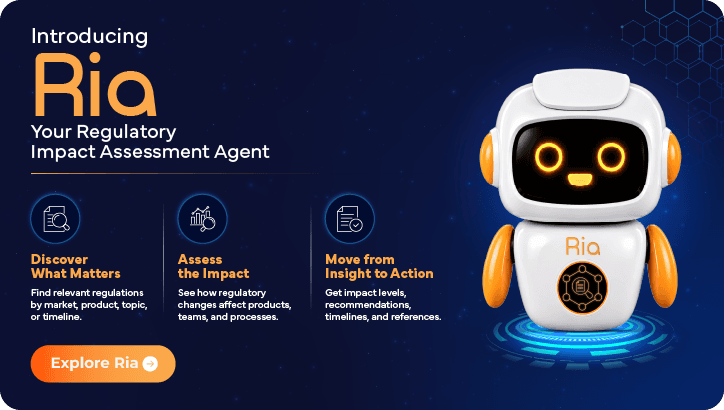
Your Regulatory Impact Assessment Agent for Turning Change into Action Watch Ria in Action
 March 18, 2026
Regulatory professionals have always worked in an environment defined by complexity. But the scale of information they face today is unprecedented.
Health authorities across the world publish thousands of updates every year including guidance revisions, pharmacopoeial changes, inspection findings, safety communications, consultation papers. Add in trade association publications and regulatory science developments, and the information stream becomes overwhelming even for well-resourced teams.
The problem isn’t simply volume. It’s speed.
Regulatory updates now move faster than traditional monitoring workflows can realistically keep up with. By the time a team reviews and interprets a new regulatory signal, the operational window to respond may already be closing.
This is where AI regulatory intelligence chatbots are beginning to make a meaningful difference.
These tools use natural language processing and structured regulatory databases to interpret regulatory information and answer questions in conversational form. Instead of manually searching regulatory portals (including some sources that cannot be trusted) or scanning dozens of documents, professionals can query the system directly.
That may sound like a small shift. It isn’t.
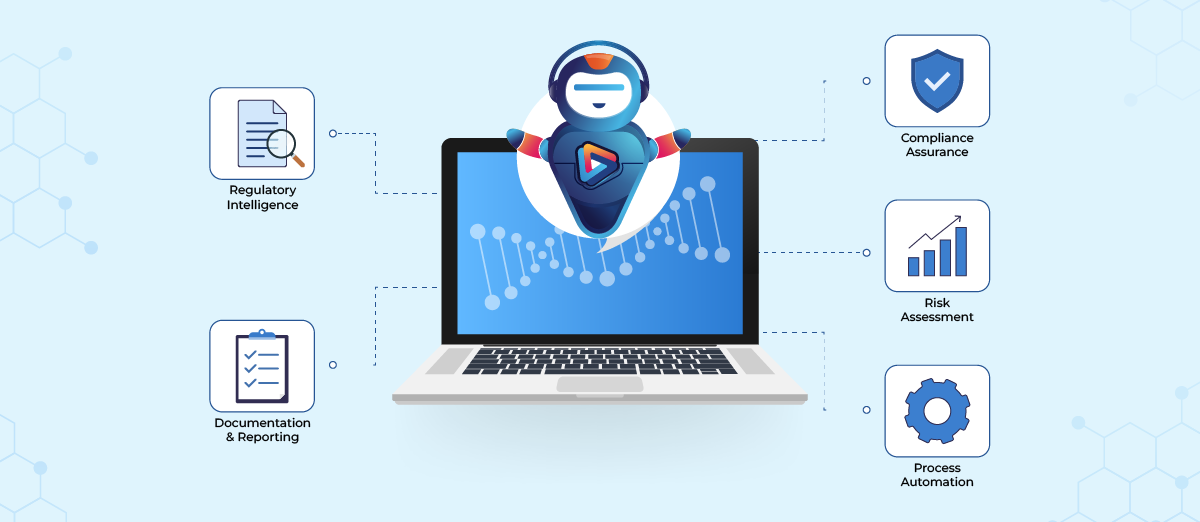
The bigger story, though, is how these tools change the way regulatory teams operate. Below are five business benefits of AI regulatory intelligence chatbots that are quietly reshaping regulatory affairs.
One of the least visible bottlenecks in regulatory affairs is the time it takes to simply find the right information.
Consider a typical scenario. A regulatory lead needs to confirm whether the FDA recently updated guidance on AI-based medical devices, or whether the EMA has modified expectations for biosimilar comparability. Finding that answer usually means navigating multiple regulatory websites, reviewing lengthy guidance documents, and interpreting context. It’s slow. And frankly, inefficient.
Regulatory intelligence chatbots compress that research process dramatically.
Instead of searching across multiple sources, teams can ask a direct question and receive:
Behind the scenes, these systems analyze large datasets including guidance documents, warning letters, consultation papers, and regulatory announcements.
The result is simple but powerful: faster regulatory decision cycles.
Here’s something many organizations underestimate.
Regulatory teams don’t struggle with interpreting regulations. They struggle with locating the right regulatory signal quickly enough to act on it.
AI chatbots solve the search problem. And that alone can reshape how regulatory strategy unfolds.
If you ask regulatory professionals where most of their time goes, the answer is rarely glamorous. It’s spent reviewing documents. Monitoring regulatory updates. Cross-checking requirements. Preparing internal summaries.
Important work, of course. But highly repetitive.
This is precisely where AI compliance automation starts to show its value.
Modern regulatory intelligence chatbots can assist with tasks such as:
None of this replaces regulatory expertise. But it removes a significant portion of the mechanical work surrounding compliance.
In practice, companies adopting AI-enabled regulatory systems report hundreds of staff hours saved each month in monitoring and regulatory research tasks. See one of our success stories here: Link
For teams already operating under intense timelines, that productivity gain matters.
Regulatory failures rarely appear out of nowhere.
More often, they emerge slowly through missed guidance updates, outdated internal processes, or subtle shifts in regulatory expectations that go unnoticed.
Large organizations, especially those operating across multiple regions, simply cannot manually track every relevant regulatory signal.
This is where AI risk reduction capabilities become valuable.AI regulatory intelligence systems continuously scan regulatory ecosystems and flag patterns such as:
These signals help organizations move from reactive compliance to proactive regulatory management. AI can also analyze historical regulatory interactions. In some cases, systems have been used to predict likely regulatory authority questions during submission reviews helping teams prepare stronger responses in advance.
Compliance failures are often described as “unexpected.” In reality, they’re usually preceded by warning signals. The challenge isn’t identifying those signals—it’s seeing them early enough. AI tools are particularly good at that.
Compliance is expensive. Large pharmaceutical organizations maintain entire teams dedicated to regulatory intelligence, monitoring global updates and supporting regulatory strategy. Add external regulatory subscriptions and consulting support, and the cost structure grows quickly.
AI regulatory intelligence tools introduce efficiencies in several areas.
For example:
Financial impact goes beyond operational savings. Earlier regulatory approvals can translate directly into extended commercialization windows and increased product revenue, particularly in high-value therapeutic areas.
The regulatory landscape isn’t becoming simpler. If anything, the opposite is true.
New regulatory frameworks are emerging around:
Meanwhile, traditional product categories continue to evolve through new guidance and regulatory expectations. Manual regulatory intelligence models struggle to scale in this environment.
Regulatory process automation, powered by AI, offers a more sustainable approach.
AI regulatory intelligence chatbots can automatically:
The effect is subtle but powerful. Regulatory intelligence becomes continuous rather than periodic.
Instead of quarterly reports or manual tracking exercises, organizations gain a real-time view of evolving regulatory expectations.
There is one misconception worth addressing.
AI regulatory chatbots are sometimes portrayed as replacements for regulatory professionals. They are not.
AI systems are extremely effective at data processing and information retrieval. But regulatory interpretation that is deciding how a regulatory change affects strategy, risk, and product development still requires human expertise.
The most successful organizations are adopting a hybrid model:
AI surfaces the regulatory intelligence. Humans apply the regulatory judgment.
That combination is where the real value emerges.
freya, our AI-powered regulatory intelligence chatbot, is designed specifically for life sciences regulatory teams.
freya allows professionals to:
Instead of navigating multiple regulatory databases, teams can simply ask freya a question and receive relevant regulatory insights within seconds (all backed by our experts).
If you’re curious how AI-driven regulatory intelligence actually works in practice, you can take freya for a free test drive today. Try Now!
Sometimes the easiest way to understand a technology is simply to ask it a question.
The benefits of AI regulatory intelligence chatbots include faster access to regulatory information, improved compliance productivity, and better regulatory efficiency. These tools help regulatory teams quickly interpret global regulatory updates, reducing the time spent searching for guidance documents and enabling faster compliance decisions.
Regulatory intelligence chatbots improve compliance productivity by automating tasks such as monitoring regulatory updates, summarizing guidance documents, and answering compliance-related questions instantly. This allows regulatory professionals to focus more on strategy and interpretation rather than manual regulatory research.
Yes. AI regulatory intelligence systems continuously monitor global regulatory updates and identify potential compliance risks earlier. By surfacing relevant regulatory signals and guidance changes in real time, these tools support AI risk reduction and help organizations avoid costly compliance gaps.
AI compliance automation improves regulatory efficiency by automatically tracking regulatory updates, organizing regulatory information, and providing instant answers to regulatory queries. This reduces manual monitoring work and helps teams respond faster to evolving regulatory requirements.
Yes. AI-driven compliance technologies can lead to significant regulatory cost savings by reducing manual regulatory monitoring, accelerating submission preparation, and minimizing costly resubmissions. Over time, these efficiencies improve overall compliance performance across regulatory teams.






Get your regulatory dose of information delivered straight to your inbox every month!
Subscribe Now